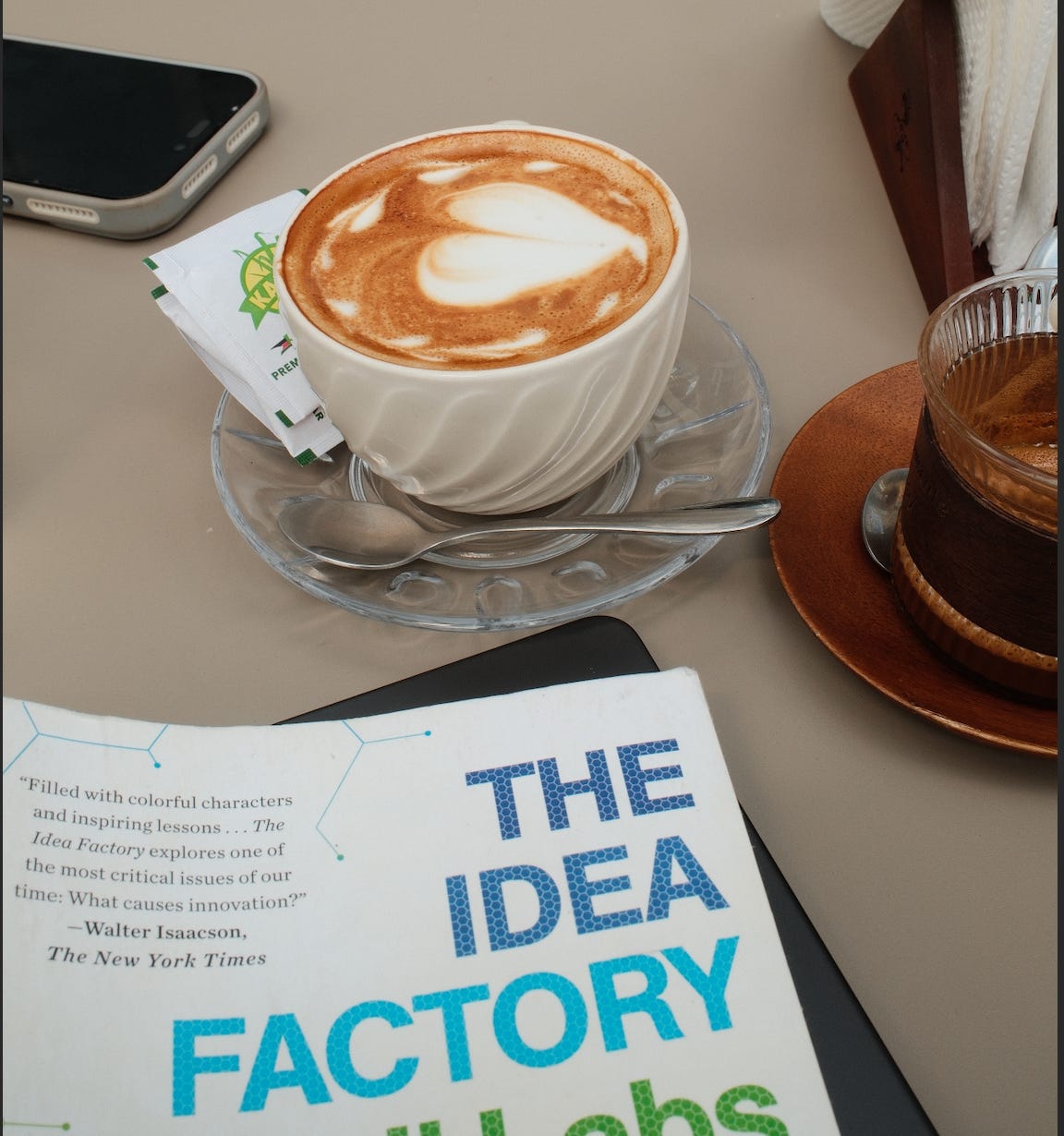
i recently finished jon gertner’s the idea factory, and one thing i kept thinking about while reading it was how much of our modern world rests on discoveries made decades ago by people most of us have never heard of.
think about the telephone. we can call someone thousands of miles away without giving it a second thought. we send messages, share files and communicate across continents in seconds. but there was a time when transmitting a voice over relatively long distances was a serious engineering problem.
this is what made the book particularly interesting to me. it takes you through the evolution of communication technology, from its relatively rudimentary beginnings to the scientific developments that eventually made modern telecommunications possible.
the people
bell labs brought together some remarkable minds. people like claude shannon, william shockley, john pierce and mervin kelly.
shannon’s work on information theory, for instance, gave us a mathematical framework for understanding information and its transmission. the transistor, developed by shockley, bardeen and brattain, would eventually become one of the most important inventions in the history of electronics.
what struck me was the amount of time, thought and experimentation that went into these developments. these weren’t people simply looking for the next product to launch. many were absorbed in fundamental questions about how the world worked and how existing limitations could be overcome.
it is easy to look at a finished invention and appreciate its usefulness. reading about the people and the circumstances surrounding its development gives you a different appreciation of what it actually took.
the bell labs experiment
beyond the inventions, i found the institution itself particularly interesting.
bell labs was an unusual environment. it brought together physicists, mathematicians, engineers and researchers, often working on problems that extended beyond the immediate needs of the telephone business.
there was an understanding that fundamental research could take years to produce something useful. some discoveries would have applications that their inventors couldn’t have anticipated.
this is probably my biggest takeaway from the book. today, much of the technology industry operates around short product cycles, immediate returns and measurable growth. there is considerable pressure to demonstrate value quickly.
bell labs offers an interesting contrast. it shows what can happen when an organisation is willing to commit resources to understanding difficult problems, even when the commercial outcome isn’t immediately clear.
of course, the arrangement was made possible by the peculiar economic position of at&t at the time. that context matters, and the book doesn’t shy away from the complications surrounding the institution. still, there is something worth examining in the model.
looking back
i think we sometimes underestimate the amount of accumulated human effort behind the conveniences of modern life.
the phone in your pocket is the result of contributions from generations of scientists, engineers and researchers. the same goes for the computing technologies, communication infrastructure and electronic systems that now underpin almost everything we do.
reading this book made me think about that progression in a much more tangible way.
it also made me think about how we remember technological history. we tend to focus on the companies and products that eventually reach the consumer, while the foundational research and the people responsible for it receive considerably less attention.
the idea factory is a good reminder to look further back.
if you’re interested in the history of technology, scientific discovery or simply understanding how we arrived at the world we live in today, i’d recommend it.